


 Ai and Tools
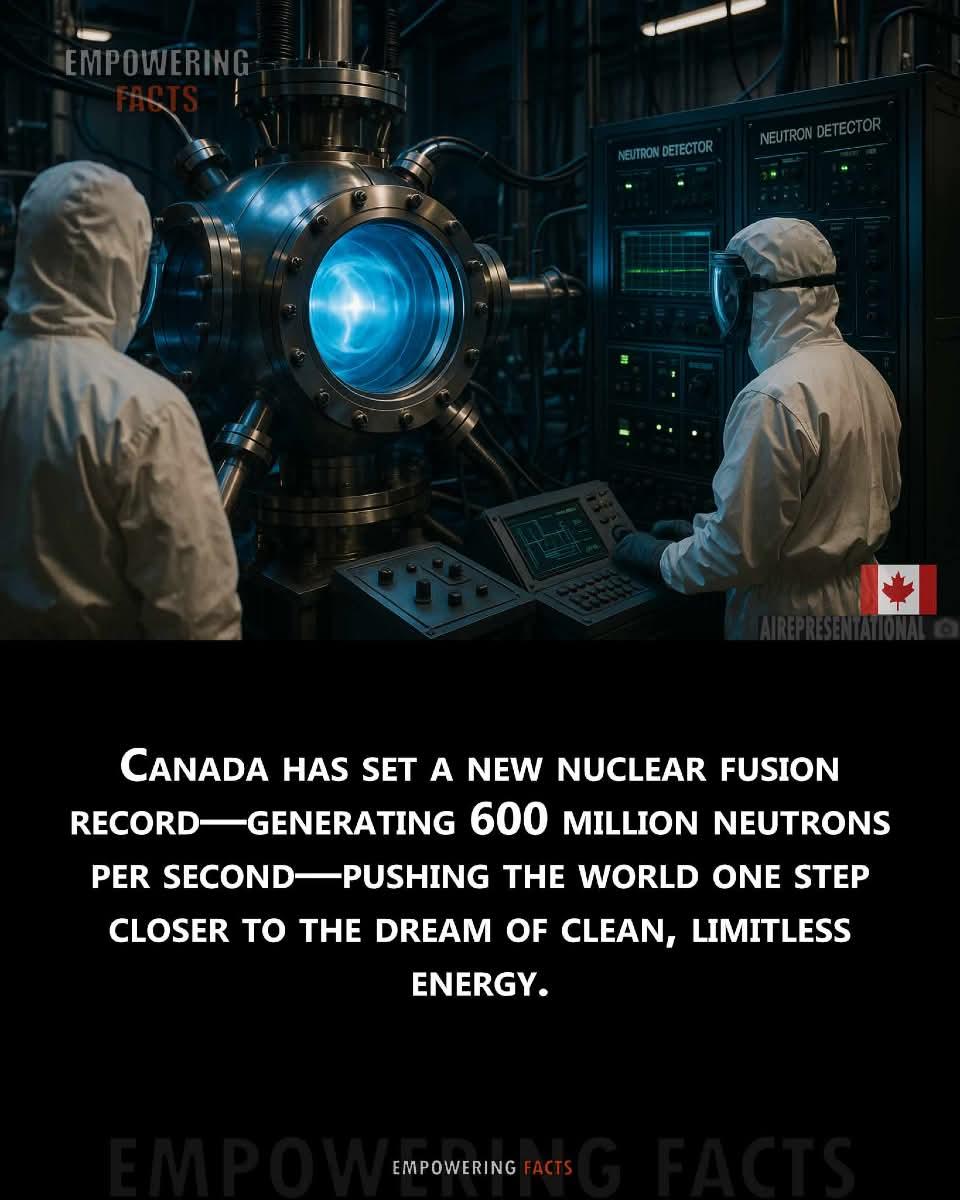
In a major breakthrough for energy science, researchers in Canada have achieved a record-setting output in nuclear fusion, generating 600 million neutrons per second during a controlled reaction. This milestone was accomplished using advanced fusion reactor technology designed to replicate the processes that power the sun—where light atomic nuclei fuse to form heavier ones, releasing vast amounts of energy in the process.
Unlike fission, which splits atoms and produces long-lived radioactive waste, fusion uses elements like hydrogen isotopes and creates minimal byproducts. The Canadian team, using a small spherical tokamak system, demonstrated that high neutron generation is possible in compact and efficient setups, without relying on enormous reactor infrastructure. This not only proves that fusion is viable on a smaller scale, but also confirms significant steps toward sustained, net-positive fusion reactions.
The generation of 600 million neutrons per second is significant because neutrons are direct indicators of fusion activity. While this doesn’t yet equate to continuous power output, it's a crucial step in achieving energy breakeven—where more energy is produced than consumed. With further refinement, such developments could one day lead to power plants that generate nearly limitless electricity from just a few grams of fuel.
Canada’s achievement adds momentum to global fusion research, signaling that a clean, safe, and sustainable energy future may be closer than previously imagined. It’s not science fiction anymore—it's science, advancing with every neutron. ⚛️🔬
#NuclearFusion
#CleanEnergyFuture
#CanadianInnovation
Unlike fission, which splits atoms and produces long-lived radioactive waste, fusion uses elements like hydrogen isotopes and creates minimal byproducts. The Canadian team, using a small spherical tokamak system, demonstrated that high neutron generation is possible in compact and efficient setups, without relying on enormous reactor infrastructure. This not only proves that fusion is viable on a smaller scale, but also confirms significant steps toward sustained, net-positive fusion reactions.
The generation of 600 million neutrons per second is significant because neutrons are direct indicators of fusion activity. While this doesn’t yet equate to continuous power output, it's a crucial step in achieving energy breakeven—where more energy is produced than consumed. With further refinement, such developments could one day lead to power plants that generate nearly limitless electricity from just a few grams of fuel.
Canada’s achievement adds momentum to global fusion research, signaling that a clean, safe, and sustainable energy future may be closer than previously imagined. It’s not science fiction anymore—it's science, advancing with every neutron. ⚛️🔬
#NuclearFusion
#CleanEnergyFuture
#CanadianInnovation
In a major breakthrough for energy science, researchers in Canada have achieved a record-setting output in nuclear fusion, generating 600 million neutrons per second during a controlled reaction. This milestone was accomplished using advanced fusion reactor technology designed to replicate the processes that power the sun—where light atomic nuclei fuse to form heavier ones, releasing vast amounts of energy in the process.
Unlike fission, which splits atoms and produces long-lived radioactive waste, fusion uses elements like hydrogen isotopes and creates minimal byproducts. The Canadian team, using a small spherical tokamak system, demonstrated that high neutron generation is possible in compact and efficient setups, without relying on enormous reactor infrastructure. This not only proves that fusion is viable on a smaller scale, but also confirms significant steps toward sustained, net-positive fusion reactions.
The generation of 600 million neutrons per second is significant because neutrons are direct indicators of fusion activity. While this doesn’t yet equate to continuous power output, it's a crucial step in achieving energy breakeven—where more energy is produced than consumed. With further refinement, such developments could one day lead to power plants that generate nearly limitless electricity from just a few grams of fuel.
Canada’s achievement adds momentum to global fusion research, signaling that a clean, safe, and sustainable energy future may be closer than previously imagined. It’s not science fiction anymore—it's science, advancing with every neutron. ⚛️🔬
#NuclearFusion
#CleanEnergyFuture
#CanadianInnovation
0 التعليقات
0 المشاركات
616 مشاهدة



 English
 Bangla
 Spanish
 China
China
 French
 German
 Russian