


 Ai and Tools
A Halo of Gravity: James Webb Captures a Near-Perfect Einstein Ring in Deep Space
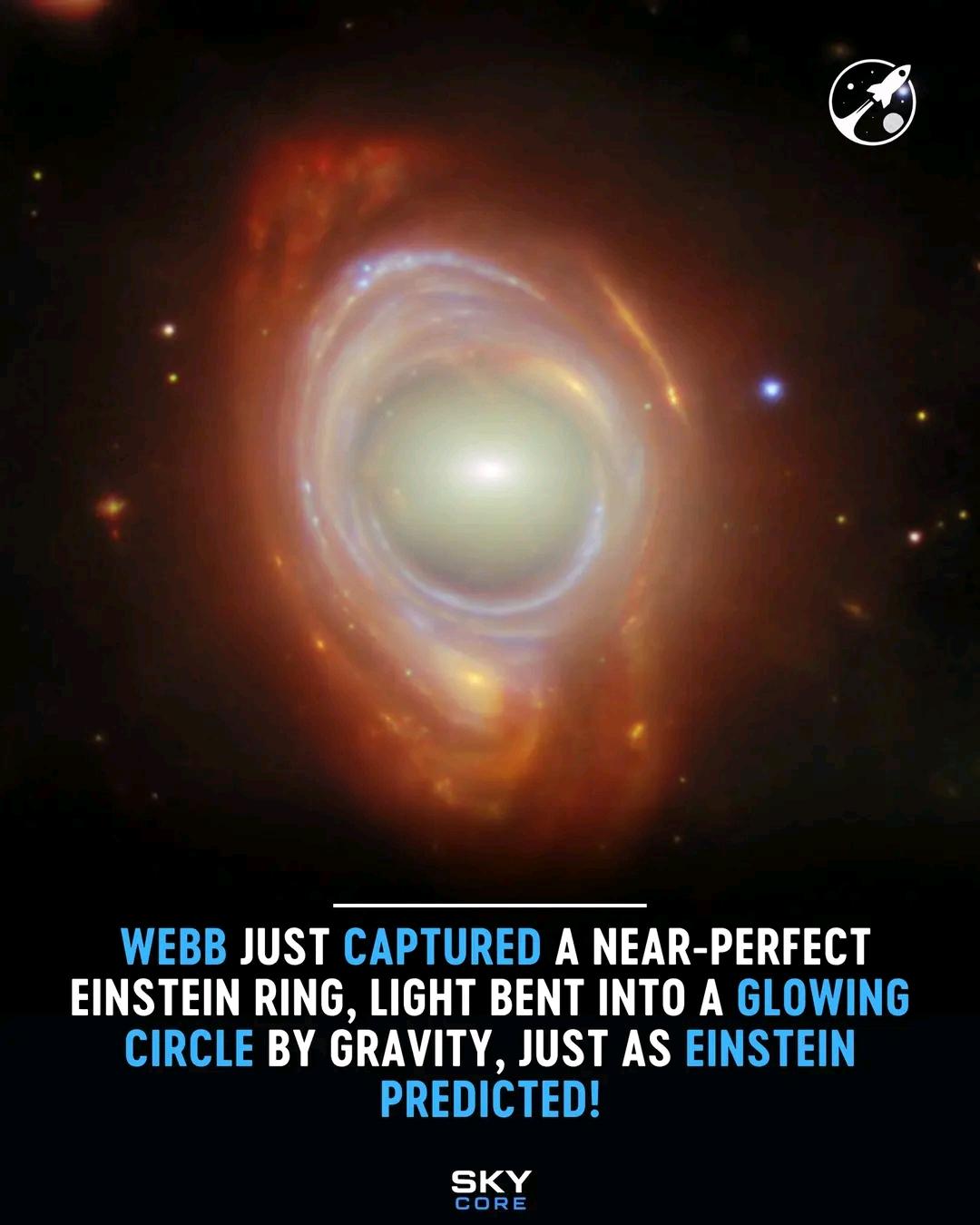
In a breathtaking display of cosmic geometry and physics, the James Webb Space Telescope (JWST) has captured one of the universe’s most stunning and rare phenomena: a near-perfect Einstein ring. This luminous loop of distorted light is more than just a beautiful sight it’s a living demonstration of Einstein’s theory of general relativity, proving once again that space itself can bend and twist under the weight of gravity.
The ring forms around galaxy cluster SMACS J0028.2-7537, where a massive elliptical galaxy in the foreground acts as a gravitational lens, bending and magnifying the light from a distant spiral galaxy located billions of light-years farther away. When the background galaxy, the lensing foreground galaxy, and Earth are perfectly aligned, the light stretches into a symmetrical, glowing ring a spectacle Einstein predicted back in 1936, though he doubted such a formation would ever be observable with the technology of his time.
Now, nearly a century later, JWST has proven Einstein wrong in the most spectacular fashion. With its unrivaled infrared vision, the telescope has not only detected the Einstein ring but also revealed its delicate, swirling structure in incredible detail. The spiral galaxy wrapped into the ring is thought to be similar in form to our Milky Way, offering a rare glimpse into deep cosmic history magnified and restructured by the very fabric of space.
Credit: Image and scientific data courtesy of NASA/ESA/CSA via the James Webb Space Telescope; lensing details from the SMACS J0028.2-7537 galaxy cluster observations, July 2025.
In a breathtaking display of cosmic geometry and physics, the James Webb Space Telescope (JWST) has captured one of the universe’s most stunning and rare phenomena: a near-perfect Einstein ring. This luminous loop of distorted light is more than just a beautiful sight it’s a living demonstration of Einstein’s theory of general relativity, proving once again that space itself can bend and twist under the weight of gravity.
The ring forms around galaxy cluster SMACS J0028.2-7537, where a massive elliptical galaxy in the foreground acts as a gravitational lens, bending and magnifying the light from a distant spiral galaxy located billions of light-years farther away. When the background galaxy, the lensing foreground galaxy, and Earth are perfectly aligned, the light stretches into a symmetrical, glowing ring a spectacle Einstein predicted back in 1936, though he doubted such a formation would ever be observable with the technology of his time.
Now, nearly a century later, JWST has proven Einstein wrong in the most spectacular fashion. With its unrivaled infrared vision, the telescope has not only detected the Einstein ring but also revealed its delicate, swirling structure in incredible detail. The spiral galaxy wrapped into the ring is thought to be similar in form to our Milky Way, offering a rare glimpse into deep cosmic history magnified and restructured by the very fabric of space.
Credit: Image and scientific data courtesy of NASA/ESA/CSA via the James Webb Space Telescope; lensing details from the SMACS J0028.2-7537 galaxy cluster observations, July 2025.
A Halo of Gravity: James Webb Captures a Near-Perfect Einstein Ring in Deep Space
In a breathtaking display of cosmic geometry and physics, the James Webb Space Telescope (JWST) has captured one of the universe’s most stunning and rare phenomena: a near-perfect Einstein ring. This luminous loop of distorted light is more than just a beautiful sight it’s a living demonstration of Einstein’s theory of general relativity, proving once again that space itself can bend and twist under the weight of gravity.
The ring forms around galaxy cluster SMACS J0028.2-7537, where a massive elliptical galaxy in the foreground acts as a gravitational lens, bending and magnifying the light from a distant spiral galaxy located billions of light-years farther away. When the background galaxy, the lensing foreground galaxy, and Earth are perfectly aligned, the light stretches into a symmetrical, glowing ring a spectacle Einstein predicted back in 1936, though he doubted such a formation would ever be observable with the technology of his time.
Now, nearly a century later, JWST has proven Einstein wrong in the most spectacular fashion. With its unrivaled infrared vision, the telescope has not only detected the Einstein ring but also revealed its delicate, swirling structure in incredible detail. The spiral galaxy wrapped into the ring is thought to be similar in form to our Milky Way, offering a rare glimpse into deep cosmic history magnified and restructured by the very fabric of space.
Credit: Image and scientific data courtesy of NASA/ESA/CSA via the James Webb Space Telescope; lensing details from the SMACS J0028.2-7537 galaxy cluster observations, July 2025.
0 Kommentare
0 Geteilt
445 Ansichten

 English
 Bangla
 Spanish
 China
China
 Arabic
 French
 Russian