

 Ai and Tools
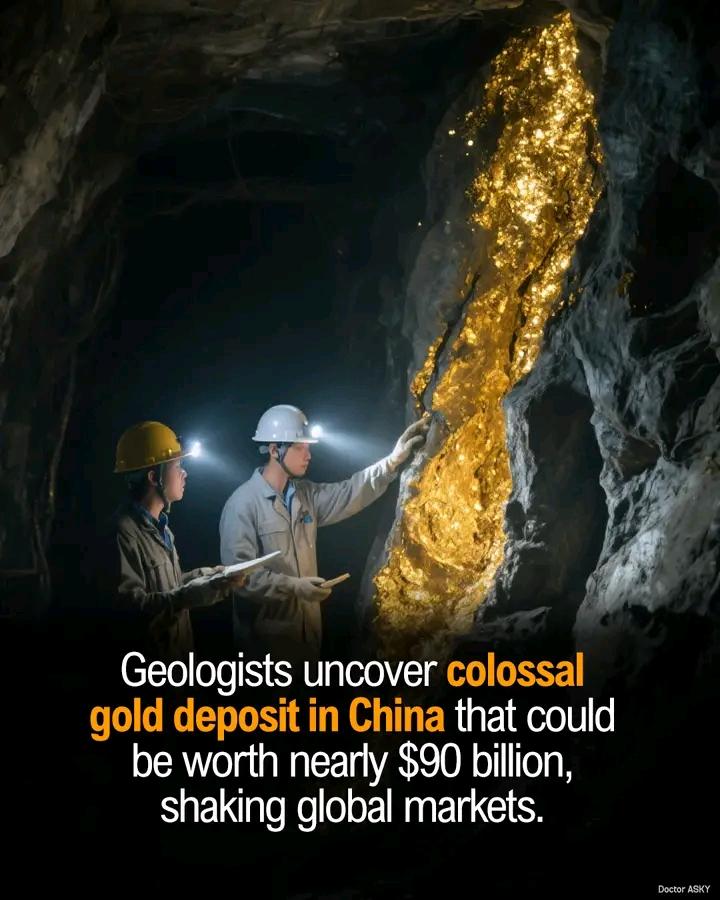
Geologists in China have stumbled upon what might be one of the largest gold treasures ever found, and it’s already sending ripples through global markets. This “supergiant” gold ore deposit was discovered in November 2024 deep underground in Hunan Province. Early surveys revealed an incredible 330 tons of gold spread across more than 40 veins reaching depths of about 6,600 feet.
But when researchers dug deeper — quite literally — using advanced 3D computer models, they estimated this reserve could actually hold up to a staggering 1,100 tons of gold at depths close to 9,800 feet. That would make it even bigger than South Africa’s famous South Deep mine, long considered the world’s largest known gold reserve. Valued at roughly $83 billion (or 600 billion yuan), the discovery is a game changer for China, which already leads global gold production but still imports heavily due to its enormous appetite for the precious metal.
Core samples from the site are particularly promising, with some showing as much as 138 grams of gold per metric ton — that’s a very rich concentration by mining standards. While some experts are cautious, questioning the practical ability to extract all that gold, the initial find was enough to send global gold prices soaring to around $2,700 an ounce. Even though this massive stash would only cover China’s gold needs for less than two years, it’s still a monumental find that could reshape the country’s mining landscape. This discovery was led by geologists from the Geological Bureau of Hunan Province.
But when researchers dug deeper — quite literally — using advanced 3D computer models, they estimated this reserve could actually hold up to a staggering 1,100 tons of gold at depths close to 9,800 feet. That would make it even bigger than South Africa’s famous South Deep mine, long considered the world’s largest known gold reserve. Valued at roughly $83 billion (or 600 billion yuan), the discovery is a game changer for China, which already leads global gold production but still imports heavily due to its enormous appetite for the precious metal.
Core samples from the site are particularly promising, with some showing as much as 138 grams of gold per metric ton — that’s a very rich concentration by mining standards. While some experts are cautious, questioning the practical ability to extract all that gold, the initial find was enough to send global gold prices soaring to around $2,700 an ounce. Even though this massive stash would only cover China’s gold needs for less than two years, it’s still a monumental find that could reshape the country’s mining landscape. This discovery was led by geologists from the Geological Bureau of Hunan Province.
Geologists in China have stumbled upon what might be one of the largest gold treasures ever found, and it’s already sending ripples through global markets. This “supergiant” gold ore deposit was discovered in November 2024 deep underground in Hunan Province. Early surveys revealed an incredible 330 tons of gold spread across more than 40 veins reaching depths of about 6,600 feet.
But when researchers dug deeper — quite literally — using advanced 3D computer models, they estimated this reserve could actually hold up to a staggering 1,100 tons of gold at depths close to 9,800 feet. That would make it even bigger than South Africa’s famous South Deep mine, long considered the world’s largest known gold reserve. Valued at roughly $83 billion (or 600 billion yuan), the discovery is a game changer for China, which already leads global gold production but still imports heavily due to its enormous appetite for the precious metal.
Core samples from the site are particularly promising, with some showing as much as 138 grams of gold per metric ton — that’s a very rich concentration by mining standards. While some experts are cautious, questioning the practical ability to extract all that gold, the initial find was enough to send global gold prices soaring to around $2,700 an ounce. Even though this massive stash would only cover China’s gold needs for less than two years, it’s still a monumental find that could reshape the country’s mining landscape. This discovery was led by geologists from the Geological Bureau of Hunan Province.


 English
 Bangla
 China
China
 Arabic
 French
 German
 Russian