

 Ai and Tools
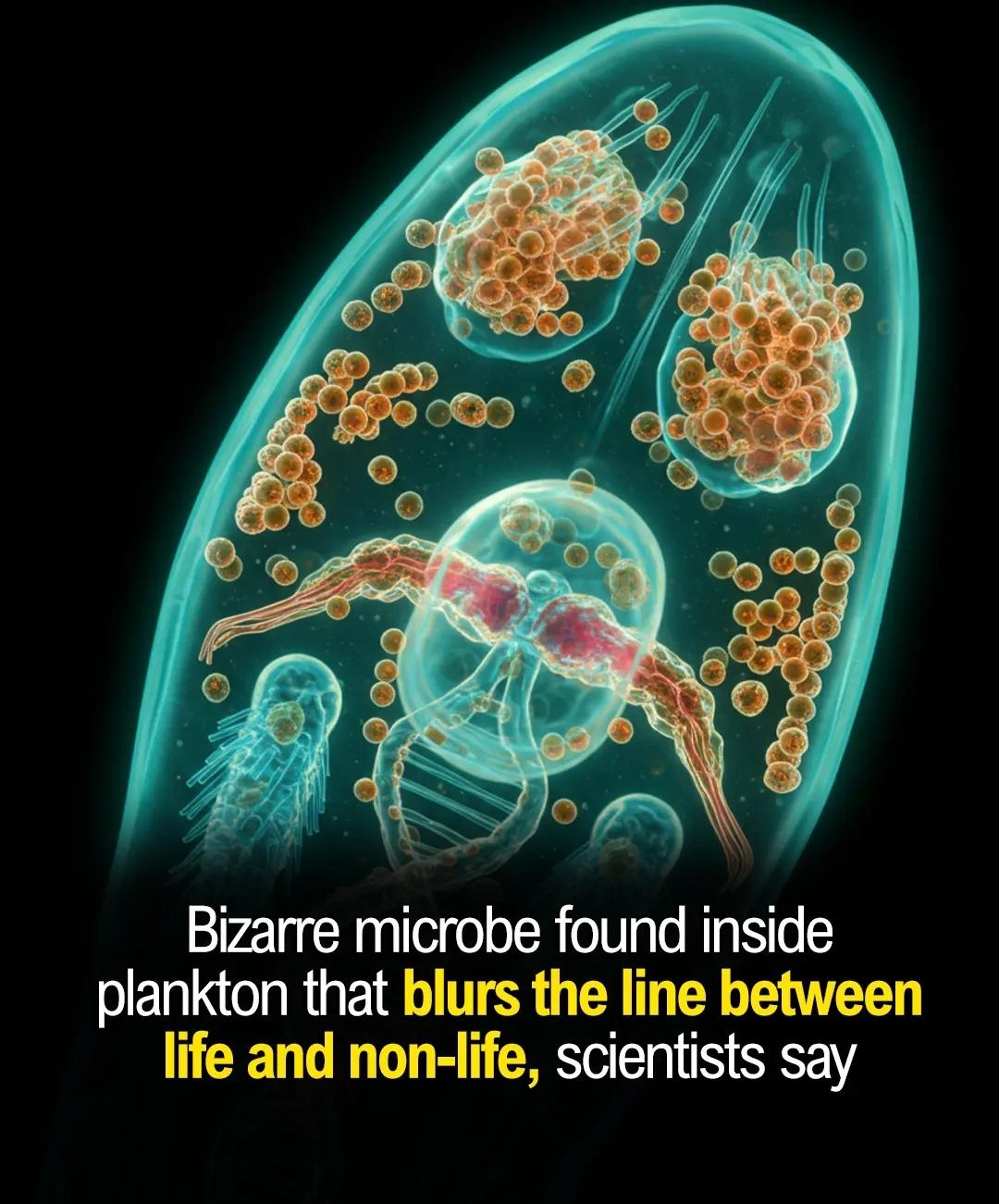
Scientists have discovered a truly weird microscopic parasite that might be the closest thing we’ve ever found to a living virus—forcing researchers to rethink where we draw the line between life and non-life. Inside a tiny plankton species called Citharistes regius, researchers from Dalhousie University uncovered an even tinier organism now called Sukunaarchaeum mirabile. This strange cell has such a stripped-down genetic blueprint that it lives almost exactly like a virus, depending entirely on its host for survival.
Sukunaarchaeum has only 238,000 DNA base pairs—far fewer than many viruses, which can have genomes over 2 million base pairs long. Like viruses, most of its genes are dedicated to copying itself, and it has virtually no machinery to handle basic life processes such as metabolism. It relies on the plankton host to do nearly everything for it. Yet unlike viruses, it still carries the genetic tools to build its own ribosomes, messenger RNA, and transfer RNA—meaning it can produce proteins and replicate its DNA on its own, even if it can’t generate energy.
This odd mix of features is shaking up scientists’ ideas about what counts as “alive.” Viruses typically aren’t considered living because they can’t reproduce or maintain themselves without hijacking another organism’s cellular machinery. Sukunaarchaeum, meanwhile, can reproduce but still needs its host to handle all the heavy lifting of staying alive. It sits in a puzzling gray area between viruses and truly independent life.
Researchers say this bizarre parasite, which belongs to the same broad group (archaea) that eventually gave rise to complex life like us, challenges fundamental ideas of what’s required for cellular life. It’s a fascinating reminder that life comes in far stranger forms than we often imagine.
RESEARCH PAPER 📄
"Ryo Harada1, Yuki Nishimura2, Mami Nomura3, Akinori Yabuki45, Kogiku Shiba6, Kazuo Inaba6, Yuji Inagaki7 and Takuro Nakayama"
A cellular entity retaining only its replicative core: Hidden archaeal lineage with an ultra-reduced genome.
Sukunaarchaeum has only 238,000 DNA base pairs—far fewer than many viruses, which can have genomes over 2 million base pairs long. Like viruses, most of its genes are dedicated to copying itself, and it has virtually no machinery to handle basic life processes such as metabolism. It relies on the plankton host to do nearly everything for it. Yet unlike viruses, it still carries the genetic tools to build its own ribosomes, messenger RNA, and transfer RNA—meaning it can produce proteins and replicate its DNA on its own, even if it can’t generate energy.
This odd mix of features is shaking up scientists’ ideas about what counts as “alive.” Viruses typically aren’t considered living because they can’t reproduce or maintain themselves without hijacking another organism’s cellular machinery. Sukunaarchaeum, meanwhile, can reproduce but still needs its host to handle all the heavy lifting of staying alive. It sits in a puzzling gray area between viruses and truly independent life.
Researchers say this bizarre parasite, which belongs to the same broad group (archaea) that eventually gave rise to complex life like us, challenges fundamental ideas of what’s required for cellular life. It’s a fascinating reminder that life comes in far stranger forms than we often imagine.
RESEARCH PAPER 📄
"Ryo Harada1, Yuki Nishimura2, Mami Nomura3, Akinori Yabuki45, Kogiku Shiba6, Kazuo Inaba6, Yuji Inagaki7 and Takuro Nakayama"
A cellular entity retaining only its replicative core: Hidden archaeal lineage with an ultra-reduced genome.
Scientists have discovered a truly weird microscopic parasite that might be the closest thing we’ve ever found to a living virus—forcing researchers to rethink where we draw the line between life and non-life. Inside a tiny plankton species called Citharistes regius, researchers from Dalhousie University uncovered an even tinier organism now called Sukunaarchaeum mirabile. This strange cell has such a stripped-down genetic blueprint that it lives almost exactly like a virus, depending entirely on its host for survival.
Sukunaarchaeum has only 238,000 DNA base pairs—far fewer than many viruses, which can have genomes over 2 million base pairs long. Like viruses, most of its genes are dedicated to copying itself, and it has virtually no machinery to handle basic life processes such as metabolism. It relies on the plankton host to do nearly everything for it. Yet unlike viruses, it still carries the genetic tools to build its own ribosomes, messenger RNA, and transfer RNA—meaning it can produce proteins and replicate its DNA on its own, even if it can’t generate energy.
This odd mix of features is shaking up scientists’ ideas about what counts as “alive.” Viruses typically aren’t considered living because they can’t reproduce or maintain themselves without hijacking another organism’s cellular machinery. Sukunaarchaeum, meanwhile, can reproduce but still needs its host to handle all the heavy lifting of staying alive. It sits in a puzzling gray area between viruses and truly independent life.
Researchers say this bizarre parasite, which belongs to the same broad group (archaea) that eventually gave rise to complex life like us, challenges fundamental ideas of what’s required for cellular life. It’s a fascinating reminder that life comes in far stranger forms than we often imagine.
RESEARCH PAPER 📄
"Ryo Harada1, Yuki Nishimura2, Mami Nomura3, Akinori Yabuki45, Kogiku Shiba6, Kazuo Inaba6, Yuji Inagaki7 and Takuro Nakayama"
A cellular entity retaining only its replicative core: Hidden archaeal lineage with an ultra-reduced genome.


 Bangla
 Spanish
 China
China
 Arabic
 French
 German
 Russian