


 Ai and Tools
🌍 A quake so powerful, it shook the entire Pacific.
It all began on July 30, at ~11:24 a.m. PETT (23:24 UTC Jul 29) when a powerful 8.8 magnitude earthquake struck off Russia’s Kamchatka Peninsula, unleashing tsunami waves that raced across the Pacific at jet-like speeds. From Japan to Hawaii, Chile to California, coastlines went on high alert.
The quake originated about 118 kilometers southeast of Petropavlovsk-Kamchatsky, at a depth of approximately 19 kilometers. It was initially reported as magnitude 8.0 but later upgraded to 8.8—placing it among the six strongest earthquakes ever recorded.
This wasn’t just a regional event. It set off a tsunami that raced across the Pacific Ocean, prompting tsunami warnings for over 40 countries across four continents. That level of global alert hasn't been seen since the 2004 Indian Ocean tsunami—but even then, the warnings weren’t as Pacific-wide.
This quake occurred in the Kuril-Kamchatka Trench, where the Pacific Plate dives beneath the Okhotsk Plate. It’s part of the Pacific Ring of Fire, Earth’s most seismically active zone. Because the earthquake was shallow and along a subduction zone, it violently displaced the seafloor—pushing a massive wall of water outward in all directions.
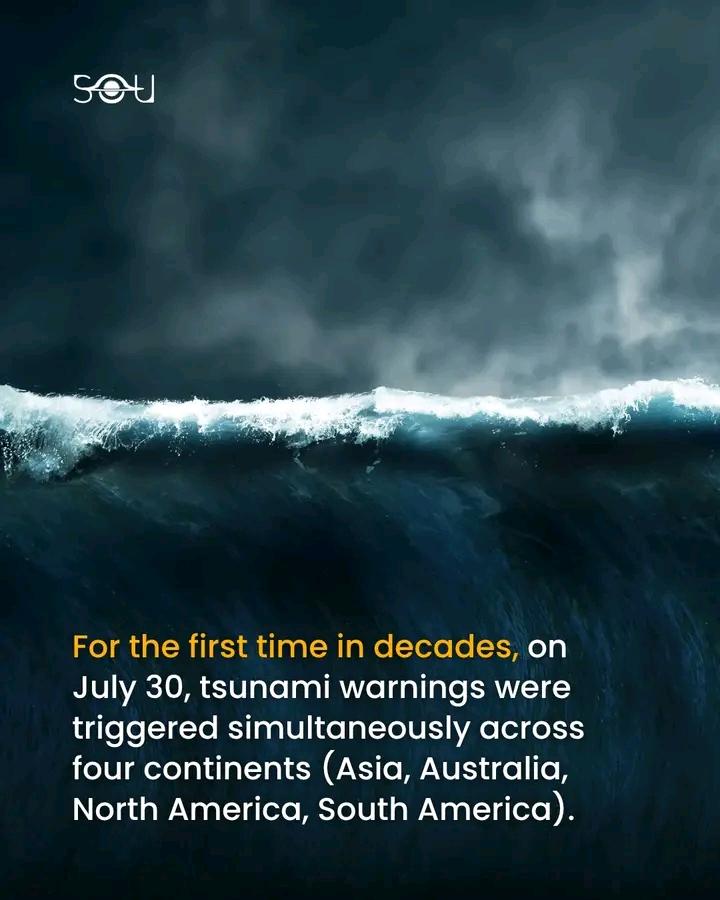
This was the first time in decades that tsunami alerts were issued across Asia, Oceania, North America, and South America simultaneously. In total, over 100 million people were placed under some form of tsunami advisory or warning.
The earthquake triggered dozens of aftershocks, including one measuring 6.9, further heightening concerns of secondary quakes or tsunamis. Fortunately, due to improved global early warning systems developed after previous disasters, mass casualties were largely avoided.
It all began on July 30, at ~11:24 a.m. PETT (23:24 UTC Jul 29) when a powerful 8.8 magnitude earthquake struck off Russia’s Kamchatka Peninsula, unleashing tsunami waves that raced across the Pacific at jet-like speeds. From Japan to Hawaii, Chile to California, coastlines went on high alert.
The quake originated about 118 kilometers southeast of Petropavlovsk-Kamchatsky, at a depth of approximately 19 kilometers. It was initially reported as magnitude 8.0 but later upgraded to 8.8—placing it among the six strongest earthquakes ever recorded.
This wasn’t just a regional event. It set off a tsunami that raced across the Pacific Ocean, prompting tsunami warnings for over 40 countries across four continents. That level of global alert hasn't been seen since the 2004 Indian Ocean tsunami—but even then, the warnings weren’t as Pacific-wide.
This quake occurred in the Kuril-Kamchatka Trench, where the Pacific Plate dives beneath the Okhotsk Plate. It’s part of the Pacific Ring of Fire, Earth’s most seismically active zone. Because the earthquake was shallow and along a subduction zone, it violently displaced the seafloor—pushing a massive wall of water outward in all directions.
This was the first time in decades that tsunami alerts were issued across Asia, Oceania, North America, and South America simultaneously. In total, over 100 million people were placed under some form of tsunami advisory or warning.
The earthquake triggered dozens of aftershocks, including one measuring 6.9, further heightening concerns of secondary quakes or tsunamis. Fortunately, due to improved global early warning systems developed after previous disasters, mass casualties were largely avoided.
🌍 A quake so powerful, it shook the entire Pacific.
It all began on July 30, at ~11:24 a.m. PETT (23:24 UTC Jul 29) when a powerful 8.8 magnitude earthquake struck off Russia’s Kamchatka Peninsula, unleashing tsunami waves that raced across the Pacific at jet-like speeds. From Japan to Hawaii, Chile to California, coastlines went on high alert.
The quake originated about 118 kilometers southeast of Petropavlovsk-Kamchatsky, at a depth of approximately 19 kilometers. It was initially reported as magnitude 8.0 but later upgraded to 8.8—placing it among the six strongest earthquakes ever recorded.
This wasn’t just a regional event. It set off a tsunami that raced across the Pacific Ocean, prompting tsunami warnings for over 40 countries across four continents. That level of global alert hasn't been seen since the 2004 Indian Ocean tsunami—but even then, the warnings weren’t as Pacific-wide.
This quake occurred in the Kuril-Kamchatka Trench, where the Pacific Plate dives beneath the Okhotsk Plate. It’s part of the Pacific Ring of Fire, Earth’s most seismically active zone. Because the earthquake was shallow and along a subduction zone, it violently displaced the seafloor—pushing a massive wall of water outward in all directions.
This was the first time in decades that tsunami alerts were issued across Asia, Oceania, North America, and South America simultaneously. In total, over 100 million people were placed under some form of tsunami advisory or warning.
The earthquake triggered dozens of aftershocks, including one measuring 6.9, further heightening concerns of secondary quakes or tsunamis. Fortunately, due to improved global early warning systems developed after previous disasters, mass casualties were largely avoided.
0 Commentaires
0 Parts
371 Vue




 English
 Bangla
 Spanish
 China
China
 Arabic
 German
 Russian